
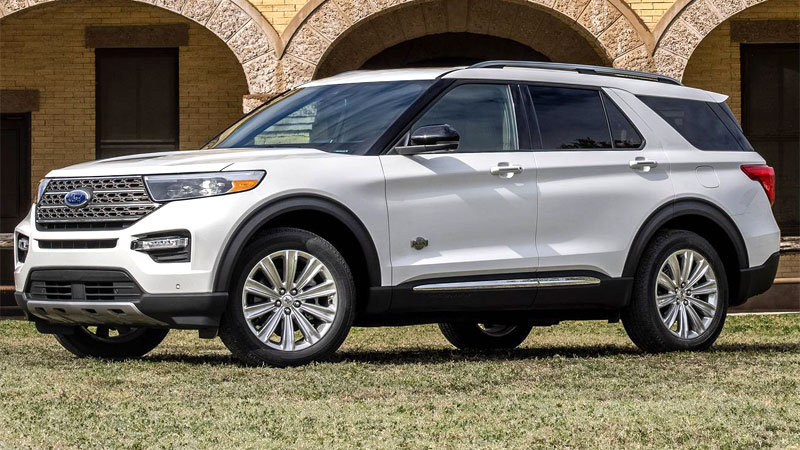
Windshield wiper blades help you maintain a clear view of what’s in front of your Ford Explorer during all types of weather. Unlike some of the other safety features on your vehicle, you will need to regularly replace your wiper blades to maintain their capabilities.
If you’ve ever struggled to find the correct wiper blades for your Explorer, the chart on this page should come as a breath of fresh air. Just look for the model year of your vehicle, and you’ll be able to quickly find the correct size. Installing the new wiper blades will help provide a clear view for many months to come.

Ford Explorer Wiper Blade Size Chart
| Year | Style | Driver | Passenger | Rear | Recommended |
|---|---|---|---|---|---|
| 2023 | SUV | 24" | 21" | 11" | Bosch ICON |
| 2022 | SUV | 24" | 21" | 11" | Bosch ICON |
| 2021 | SUV | 24" | 21" | 11" | Bosch ICON |
| 2020 | SUV | 24" | 21" | 11" | Bosch ICON |
| 2019 | SUV | 26" | 22" | 11" | Bosch ICON |
| 2018 | SUV | 26" | 22" | 11" | Bosch ICON |
| 2017 | SUV | 26" | 22" | 11" | Bosch ICON |
| 2016 | SUV | 26" | 22" | 11" | Bosch ICON |
| 2015 | SUV | 26" | 22" | 11" | Bosch ICON |
| 2014 | SUV | 26" | 22" | 11" | Bosch ICON |
| 2013 | SUV | 26" | 22" | 11" | Bosch ICON |
| 2012 | SUV | 26" | 22" | 11" | Bosch ICON |
| 2011 | SUV | 26" | 22" | 11" | Bosch ICON |
| 2010 | SUV | 20" | 20" | 13" | Bosch ICON |
| 2009 | SUV | 20" | 20" | 13" | Bosch ICON |
| 2008 | SUV | 20" | 20" | 13" | Bosch ICON |
| 2007 | SUV | 20" | 20" | 13" | Bosch ICON |
| 2006 | SUV | 20" | 20" | 13" | Bosch ICON |
| 2005 | SUV | 22" | 22" | 16" | Bosch ICON |
| 2004 | SUV | 22" | 22" | 16" | Bosch ICON |
| 2003 | SUV | 22" | 22" | 16" | Bosch ICON |
| 2002 | SUV | 22" | 22" | 16" | Bosch ICON |
| 2001 | SUV | 18" | 18" | 14" | Bosch ICON |
| 2000 | SUV | 18" | 18" | 14" | Bosch ICON |
| 1999 | SUV | 18" | 18" | 14" | Bosch ICON |
| 1998 | SUV | 18" | 18" | 14" | Bosch ICON |
| 1997 | SUV | 18" | 18" | 14" | Bosch ICON |
| 1996 | SUV | 18" | 18" | 14" | Bosch ICON |
| 1995 | SUV | 18" | 18" | 14" | Bosch ICON |
| 1994 | SUV | 18" | 18" | 14" | Bosch ICON |
| 1993 | SUV | 18" | 18" | 14" | Bosch ICON |
| 1992 | SUV | 18" | 18" | 14" | Bosch ICON |
| 1991 | SUV | 18" | 18" | 14" | Bosch ICON |
About the Ford Explorer
One of the most enduringly popular mid-size crossover SUVs, the Ford Explorer first appeared on showroom floors in 1991. Going through a whopping six generations, the Ford Explorer has long been known as a reliable family mover that makes a good substitute for a minivan.
From 1991 until 2003, the Ford Explorer also had a Sport variant. This two-door model was shorter and more nimble than its four-door counterpart. As consumers’ tastes shifted toward larger vehicles, the Explorer Sport fell out of favor.
Another variant that was produced until 2010 was the Explorer Sport Trac. This was an SUV and truck hybrid that was favored by individuals wanting a small truck.
The current Explorer packs a 300-horsepower four-cylinder engine under the hood for most trims, increasing to 400 horsepower for higher trim levels. This gives the Explorer enough power to tow up to 5,600 pounds when properly equipped.
The power and technology of the Explorer are two main qualities that buyers greatly enjoy. Despite this exceptional power, the Explorer can still get up to 28 miles per gallon on the highway, making this vehicle perfect for longer road trips.
In today’s crowded mid-size SUV market that includes the Honda Pilot, Mazda CX-9, Kia Telluride, GMC Acadia, and Toyota Highlander, the Explorer still stands apart thanks to its roomy interior and large range of available equipment.
If you’re needing to haul a lot of people and cargo in a comfortable vehicle, the Ford Explorer is a great place to start.
See Also: Ford Expedition, Ford Excursion, Ford Bronco, Ford Flex, Ford Escape,