
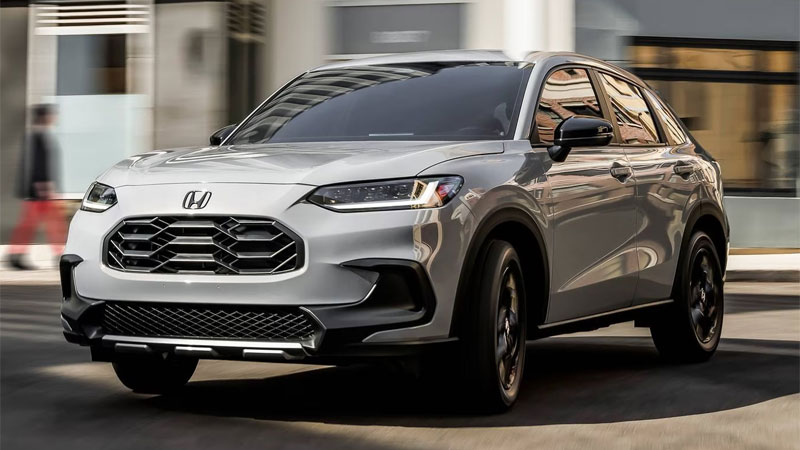
Honda HR-V owners expect a lot from small packages, including wiper blades that actually do their job. Stop putting up with chatter and squeaking by replacing your current blades with a fresh set.
Using the size chart below, you’ll find correct fitting driver, passenger, and rear wiper blades no matter what year of HR-V you drive.

Honda HR-V Wiper Blade Size Chart
| Year | Style | Driver | Passenger | Rear | Recommended |
|---|---|---|---|---|---|
| 2024 | SUV | 26" | 17" | 11" | Bosch ICON |
| 2023 | SUV | 26" | 17" | 11" | Bosch ICON |
| 2022 | SUV | 26" | 18" | 10" | Bosch ICON |
| 2021 | SUV | 26" | 18" | 10" | Bosch ICON |
| 2020 | SUV | 26" | 18" | 10" | Bosch ICON |
| 2019 | SUV | 26" | 18" | 10" | Bosch ICON |
| 2018 | SUV | 26" | 18" | 10" | Bosch ICON |
| 2017 | SUV | 26" | 18" | 10" | Bosch ICON |
| 2016 | SUV | 26" | 18" | 10" | Bosch ICON |
About the Honda HR-V
The Honda HR-V is a crossover SUV that has been part of Honda’s lineup since its introduction in 1999 in Japan and other select markets. However, it wasn’t until the second generation, introduced in 2015, that the HR-V became widely recognized and available globally, including in the American market.
It was positioned as an entry-level crossover SUV, below the larger CR-V in Honda’s lineup. The US version of the HR-V was designed to cater to the increasing demand for smaller, more fuel-efficient, yet versatile vehicles and based on the third-generation Honda Fit.
For the 2019 model year, the HR-V received a mid-cycle refresh that included updated exterior styling, with a new grille and headlight design, as well as new wheel designs. The interior saw enhancements too, with higher trim levels receiving a new infotainment system with Apple CarPlay and Android Auto compatibility.
Safety features were also bolstered by the addition of Honda Sensing on certain trims, which included technologies like adaptive cruise control and collision mitigation braking.
The HR-V continued to evolve, and in 2022, Honda launched the third-generation HR-V for the 2023 model year in the United States. This new model was developed specifically for the North American market, diverging from the version sold internationally. It featured a more rugged design, larger dimensions, and a more powerful engine, aiming to better meet the expectations of American consumers.
As for its competitors, throughout different model years, the Honda HR-V has been compared to a variety of other vehicles in its class. Notable models include the Jeep Renegade, Subaru Crosstrek, Mazda CX-30 and CX-5, Nissan Kicks, and Toyota Corolla Cross. These vehicles represent a cross-section of the subcompact SUV market and provide various options for consumers with different preferences and priorities.
See Also: Honda Pilot Wiper Blade Sizes, Honda Crosstour Wiper Blade Sizes