
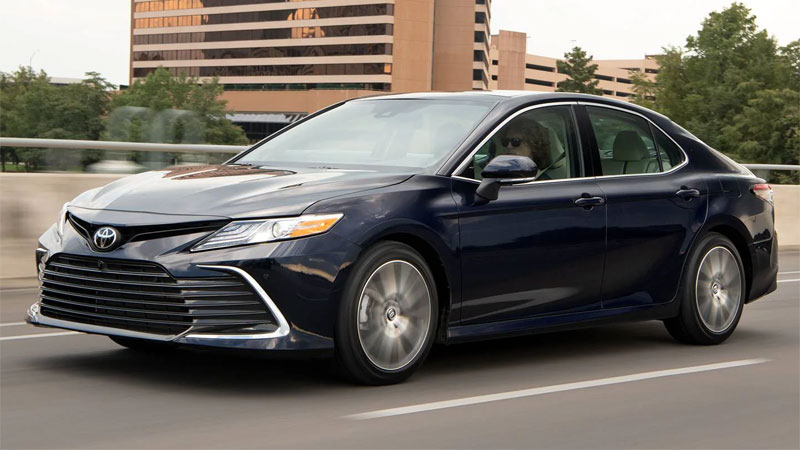
Have you visited the wiper blade aisle at your local big box store recently? If you have, you know how intimidating it can be to stand in front of a long row of hundreds of different wiper blades as you try and figure out which blades you need for your Toyota Camry.
After a quick glance at the chart on this page, though, browsing wiper blades will be a thing of the past. You’ll be able to conquer all types of weather conditions with ease with your new wiper blades, allowing you to arrive safely at your destination.

Toyota Camry Wiper Blade Size Chart
| Year | Style | Driver | Passenger | Rear | Recommended |
|---|---|---|---|---|---|
| 2023 | Sedan | 26" | 20" | n/a | Bosch ICON |
| 2022 | Sedan | 26" | 20" | n/a | Bosch ICON |
| 2021 | Sedan | 26" | 20" | n/a | Bosch ICON |
| 2020 | Sedan | 26" | 20" | n/a | Bosch ICON |
| 2019 | Sedan | 26" | 20" | n/a | Bosch ICON |
| 2018 | Sedan | 26" | 20" | n/a | Bosch ICON |
| 2017 | Sedan | 26" | 18" | n/a | Bosch ICON |
| 2016 | Sedan | 26" | 18" | n/a | Bosch ICON |
| 2015 | Sedan | 26" | 18" | n/a | Bosch ICON |
| 2014 | Sedan | 26" | 18" | n/a | Bosch ICON |
| 2013 | Sedan | 26" | 18" | n/a | Bosch ICON |
| 2012 | Sedan | 26" | 18" | n/a | Bosch ICON |
| 2011 | Sedan | 24" | 20" | n/a | Bosch ICON |
| 2010 | Sedan | 24" | 20" | n/a | Bosch ICON |
| 2009 | Sedan | 24" | 20" | n/a | Bosch ICON |
| 2008 | Sedan | 24" | 20" | n/a | Bosch ICON |
| 2007 | Sedan | 24" | 20" | n/a | Bosch ICON |
| 2006 | Sedan | 24" | 19" | n/a | Bosch ICON |
| 2005 | Sedan | 24" | 19" | n/a | Bosch ICON |
| 2004 | Sedan | 24" | 19" | n/a | Bosch ICON |
| 2003 | Sedan | 24" | 19" | n/a | Bosch ICON |
| 2002 | Sedan | 24" | 19" | n/a | Bosch ICON |
| 2001 | Sedan | 21" | 19" | n/a | Bosch ICON |
| 2000 | Sedan | 21" | 19" | n/a | Bosch ICON |
| 1999 | Sedan | 21" | 19" | n/a | Bosch ICON |
| 1998 | Sedan | 21" | 19" | n/a | Bosch ICON |
| 1997 | Sedan | 21" | 19" | n/a | Bosch ICON |
| 1996 | Sedan | 21" | 19" | n/a | Bosch ICON |
| 1996 | Wagon | 21" | 19" | 13" | Bosch ICON |
| 1995 | Sedan | 21" | 19" | n/a | Bosch ICON |
| 1995 | Wagon | 21" | 19" | 13" | Bosch ICON |
| 1994 | Sedan | 21" | 19" | n/a | Bosch ICON |
| 1994 | Wagon | 21" | 19" | 13" | Bosch ICON |
| 1993 | Sedan | 21" | 19" | n/a | Bosch ICON |
| 1993 | Wagon | 21" | 19" | 13" | Bosch ICON |
| 1992 | Sedan | 21" | 19" | n/a | Bosch ICON |
| 1992 | Wagon | 21" | 19" | 13" | Bosch ICON |
About the Toyota Camry
The Toyota Camry has been a stalwart mid-size sedan since it first hit showroom floors in 1982. Toyota has not allowed the Camry to become stale, transforming it through eight generations of development. The Camry continues to be one of Toyota’s most innovative models, now coming in a hybrid variant that can achieve fuel economy of up to 53 miles per gallon.
Throughout much of its history, the Camry was relegated to the realm of unimpressive sedans that were reliable and comfortable without being exciting. That’s not the case for today’s Camry. Featuring up to 301 horsepower, the Camry can rocket to 60 miles per hour in only 5.1 seconds. When you add in the sporty exterior styling of the Camry, it’s easy to see why the Camry is a favorite among driving enthusiasts.
Other well-known vehicles compete against the Camry for the hearts and dollars of car buyers. These vehicles include the Honda Accord, Hyundai Sonata, Nissan Altima, and Volkswagen Passat. Continuous innovation and a variety of price points help the Camry to stand out from its competitors. With so many trim levels and price points to choose from, buyers can easily choose the exact configuration they want for the exact price they’re comfortable paying.
As a brand, Toyota has long been known for its safety, and the Camry has long been known for being one of its safest vehicles. The current Camry continues this trend, earning a Top Safety Pick+ award from the Insurance Institute for Highway Safety.
If you want a reliable, safe, and great-looking sedan that’s backed by years of innovation, the Toyota Camry should be at the top of your list.
See Also: Toyota Corolla, Toyota Avalon, Toyota Yaris