
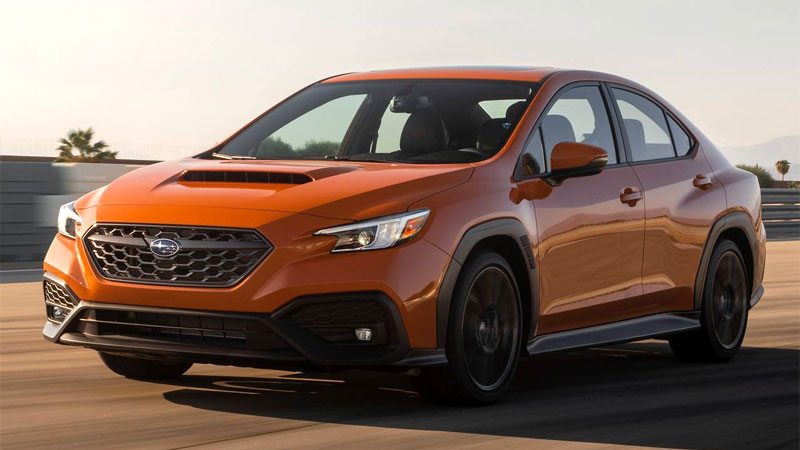
Don’t underestimate the importance of your Subaru WRX’s wiper blades. When the weather gets bad, you’ll want the protection that wiper blades offer. Old wiper blades aren’t good enough because they can reduce your visibility by leaving streaks on your windshield. Fresh wiper blades are what you need.
Since different model years of various vehicles use different sizes of wiper blades, it’s important to consult the chart on this page to ensure you buy the correct wiper blades for your WRX. This will prevent you from wasting time and money. You’ll also be glad to know that wiper blades are quite easy to install, making this a great vehicle maintenance project.

Subaru WRX Wiper Blade Size Chart
Note: For WRX models prior to 2015, refer to the Subaru Impreza sizing page.
| Year | Style | Driver | Passenger | Recommended |
|---|---|---|---|---|
| 2023 | Sedan | 26" | 16" | Bosch ICON |
| 2022 | Sedan | 26" | 16" | Bosch ICON |
| 2021 | Sedan | 26" | 16" | Bosch ICON |
| 2020 | Sedan | 26" | 16" | Bosch ICON |
| 2019 | Sedan | 26" | 16" | Bosch ICON |
| 2018 | Sedan | 26" | 16" | Bosch ICON |
| 2017 | Sedan | 26" | 16" | Bosch ICON |
| 2016 | Sedan | 26" | 16" | Bosch ICON |
| 2015 | Sedan | 26" | 16" | Bosch ICON |
About the Subaru WRX
While Subaru isn’t the most popular vehicle manufacturer in the world, those who do buy Subaru vehicles are extremely loyal. These buyers are also picky about the cars they drive, which is why it’s no surprise that the Subaru WRX has enjoyed relative success as a sport compact car for so long.
From 1992 to 2014, it was known as the Impreza WRX. Starting in 2015, Subaru stopped marking the WRX and its high-performance variant (the WRX STI) under the Impreza name.
Although the WRX was long based on the Impreza chassis, it’s now offered as a completely separate vehicle-a powerful and fun-to-drive vehicle, at that. The 271-horsepower turbocharged engine in the WRX gives it plenty of pep. From a dead stop, the WRX can reach 60 miles per hour in less than six seconds. Opt for the 310-horsepower STI, and 60 mph arrives in about 4.5 seconds.
The WRX is designed from top to bottom to be at home on the track. It has an agile suspension to help it take tight turns with ease. The good news is that the same features that make the WRX a great fit on the track also make it a great option for normal driving.
Plus, the rally-inspired seats, sporty instrument cluster, and manual transmission help to elevate your normal driving experience so that it never gets boring to get from point A to point B. Competitors include the Honda Civic SI, Lexus IS 350, and Mitsubishi Evo among others.
In true Subaru fashion, the WRX isn’t only focused on speed and performance. The Top Safety Pick award from the Insurance Institute for Highway Safety testifies to the fact that the WRX is also an exceptionally safe car.
This is a perfect quality for a car that is sometimes tempting to drive a little too quickly. If you’re looking to leave behind your boring daily commute, put the Subaru WRX on your wish list.
See Also: Subaru BRZ, Subaru Legacy, Subaru Crosstrek